The Insect Respiratory Network

The Insect Respiratory Network

Alison Simpkins (Graduate Student)

Quantitative and Computational Biology

Stanislav Shvartsman (Faculty)

Molecular Biology

Jodi Schottenfeld-Roames (Faculty)

Molecular Biology

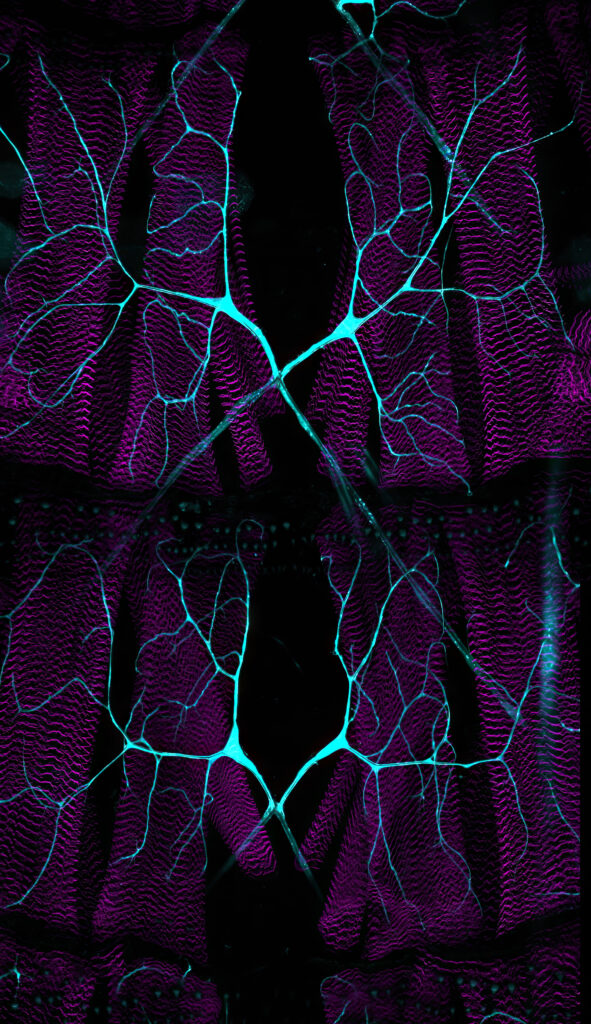
Drosophila melanogaster, otherwise known as the common fruit fly, supplies oxygen to its body through a respiratory tracheal system. Within this system are specialized terminal cells that branch out to meet the oxygen demands of nearby tissues. These cells wrap around the underlying body wall muscles, ensuring they receive a sufficient supply of oxygen.

In this image we see the tracheal system (cyan) and body wall muscles (magenta) of a developing Drosophila larva.

This research is a product of the Lewis-Sigler Institute for Integrative Genomics.
Twisted Towers
Twisted Towers

Twisted Towers

Lauren Dreier (Graduate Student)

Architecture

Tom Marzin (Postdoc)

Chemical and Biological Engineering

Pierre-Thomas Brun (Faculty)

Chemical and Biological Engineering

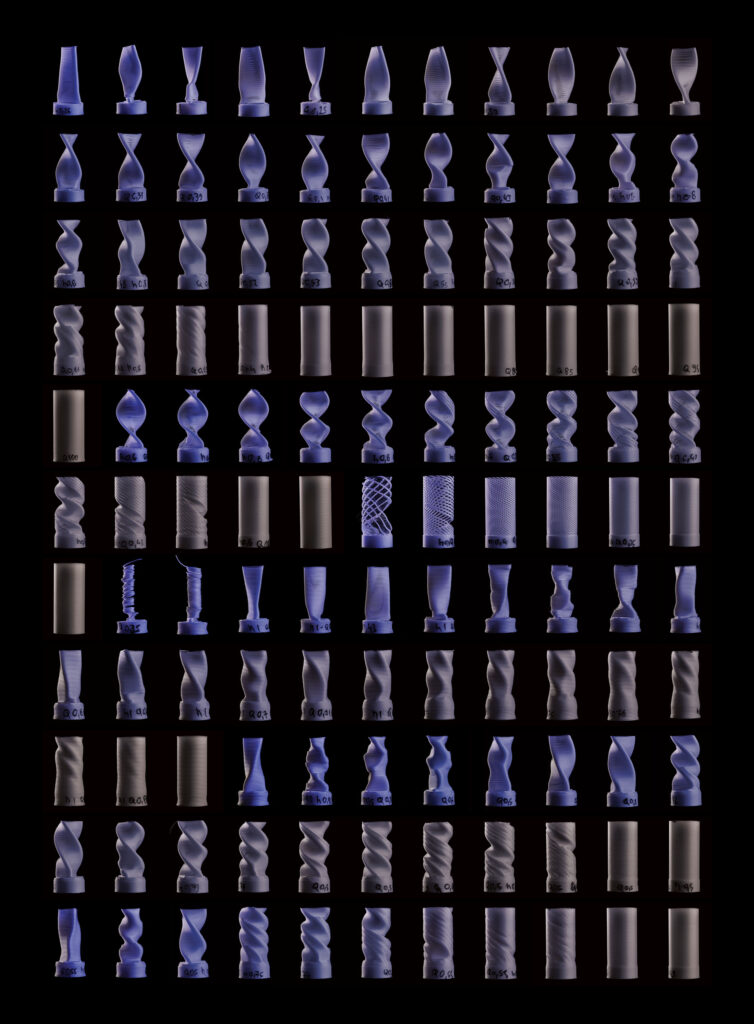
Using a 3D printer in an unconventional way can lead to twisted tower-like shapes. In these experiments, each sample was printed from bottom to top as a spiral. We then deviated from the recommended height and flow rate settings to affect how each layer sticks to one another. We found that increasing the flow rate (samples in gray) creates shorter threads and a shallower twisting pitch. As we gradually pushed the flow rate to the machine’s limit, the prints became more cylindrical.

Enemy at the Gate
Enemy at the gate

Enemy at the Gate

Jixuan Zheng (Graduate Student)

Ecology and Evolutionary Biology

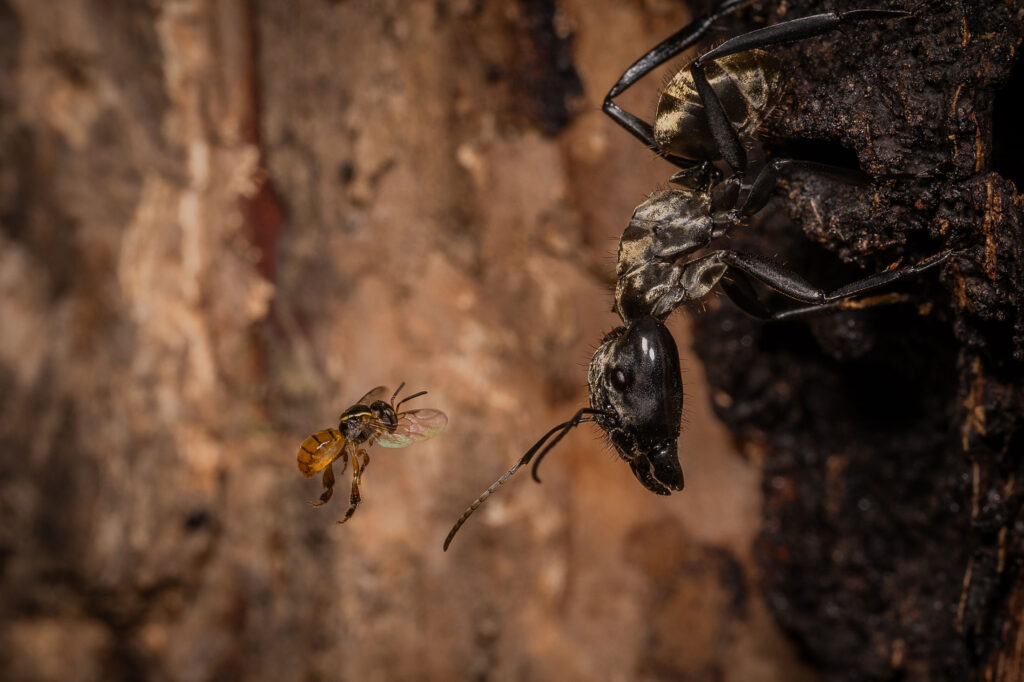
A stingless worker bee (Plebeia sp.) faces an unexpected hurdle on its way home: a giant carpenter ant
(Camponotus sericeiventris) poised to ambush. Hovering cautiously, the bee considers the best route to slip past
the guard.

Stingless bees will sometimes build their nests near ant colonies to exploit their defensive prowess, but this strategy comes with risks. The precarious alliance of these two social insects epitomize the complex relationships between rainforest inhabitants.

This photograph was taken on Barro Colorado Island, Panama during the dry season.

Eclipse Shadows on Nassau Street
Shadows from A Partial Eclipse, 2023

Eclipse Shadows on Nassau Street

James Welling (Faculty)

Visual Arts

During the partial eclipse on April 8, 2024, shadows of tree branches on Nassau Street appeared sharp on one side and fuzzy on the other. This visual effect may relate to how parallel, or collimated, rays of sunlight interact with the edge of the eclipsing Moon. One hypothesis suggests that the Moon acted like a Schlieren “light block” (a concept from optics used to visualize changes in how light moves), altering the sharpness of the branch’s shadow edges as it partially obstructed the Sun’s rays.

Impending Coalescence

Impending Coalescence

Jasmine Parsons (Graduate Student) and Anatoly Spitkovsky (Faculty)

Astrophysical Sciences

Neutron stars, the collapsed cores of massive stars, are the densest known objects in the universe. When two neutron stars merge, they produce an explosion visible across the electromagnetic spectrum, gravitational waves,
and the heaviest elements in the periodic table, including gold. As these stars approach each other, they become immersed in relativistic, magnetized plasma.

This 3D simulation captures the moment before the collision of two neutron stars, their magnetic fields, and the plasma that surrounds them.

Echinosaura Embera
Echinosaura embera

Echinosaura Embera

Daniel Vásquez-Restrepo (Graduate Student)

Ecology and Evolutionary Biology

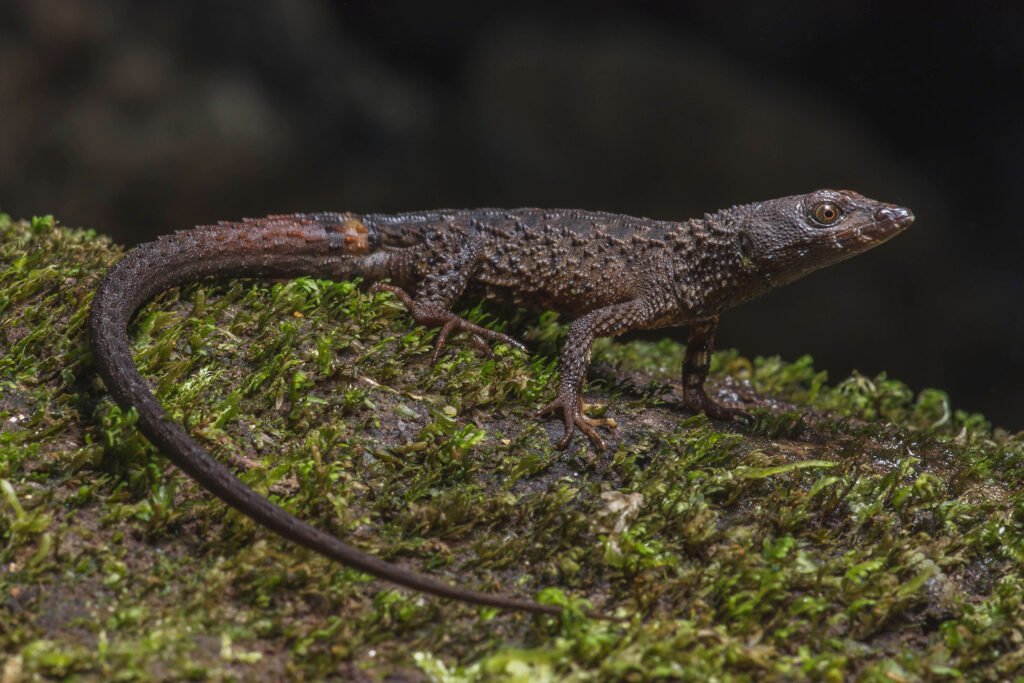
“The world was so recent that many things lacked names, and in order to indicate them, it was necessary to point.” — Gabriel García Márquez, One Hundred Years of Solitude

Echinosaura embera is a newly described species of hedgehog lizard. The genus name Echinosaura derives from Greek, meaning “spiny lizard.” The species name embera honors the indigenous groups of Colombia’s Pacific coast and Darién region, where this lizard is found. Among the western Emberá in Colombia, there is an ethnic subgroup, the Emberá-Dobidá, known as the “river people”—a fitting poetic reference, as this semi-aquatic lizard species inhabits small creeks.

Defect Blues
Defect Blues

Defect Blues

Eva S. M. Reed ’26 and Emily Ostermann (Graduate Student)

Chemical and Biological Engineering

Emily C. Davidson (Faculty)

Chemical and Biological Engineering, Princeton Materials Institute

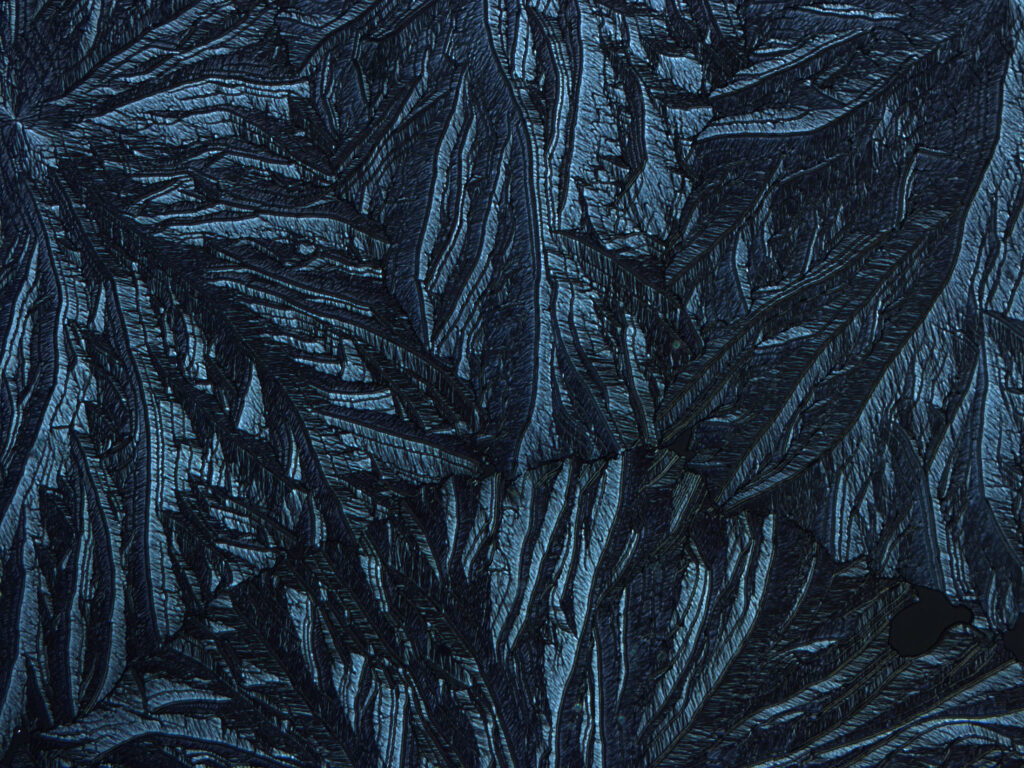
The image shows the crystalline phase of a mesogenic dimer, a small organic molecule that can form liquid crystal phases. While the material normally organizes into orderly patterns called spherulites, a combination of processing
conditions and rapid cooling induced a stunning pattern of disorder. The colors seen here emerge from birefringence—a property that varies with the orientation of crystalline regions as they interact with polarized light. The sample region seen here is 2 mm wide.

Long Live the Wrinkliest
Long live the wrinkliest

Long Live the Wrinkliest

Jonghyun Hwang (Graduate Student) and Howard A. Stone (Faculty)

Mechanical and Aerospace Engineering

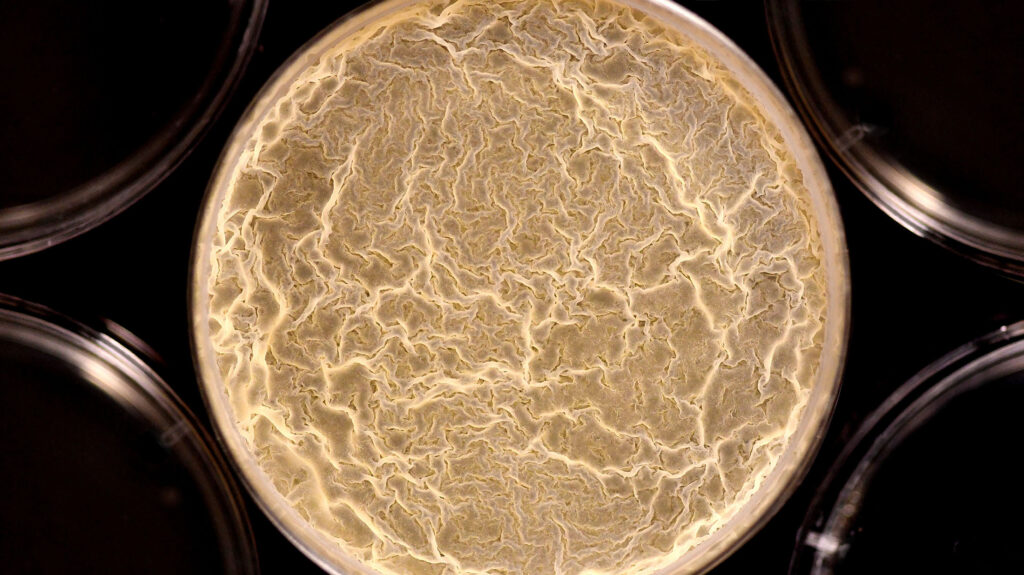
Many species of aquatic bacteria will aggregate on the surface of water in search of oxygen. These cells adhere together to form a thin and elastic biofilm called a pellicle. As more cells gather and the pellicle grows outward, a wrinkled surface forms. The structure they form provides protection against environmental stresses and enhances
their access to nutrients.

This image captures the top view of a Bacillus subtilis pellicle in a 6 cm Petri dish.

Embryonic Bird Hip
Embryonic Bird Hip

Embryonic Bird Hip

Christopher Griffin (Faculty)

Department of Geosciences

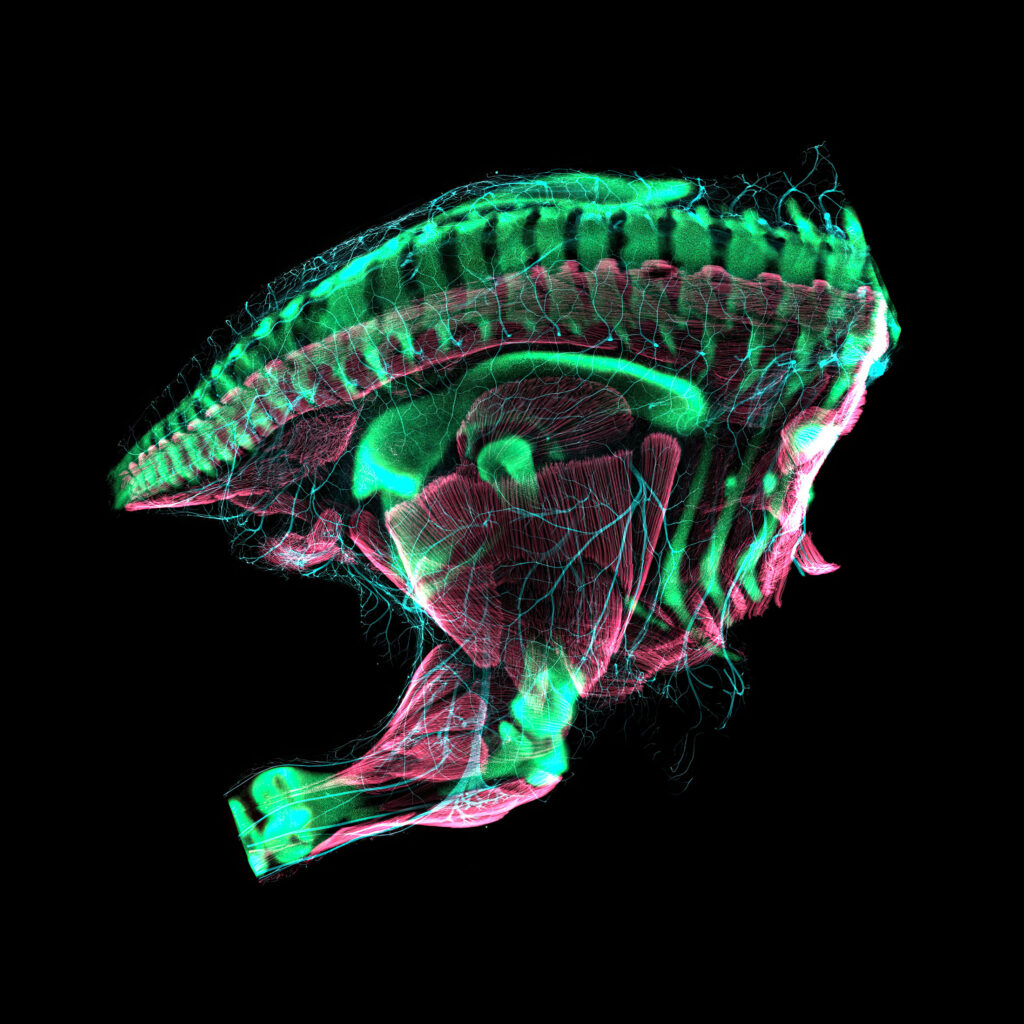
Embryonic tissues express different proteins, which can be fluorescently stained with antibodies to reveal the subtleties of developing anatomy. This is the hip region of an embryonic Japanese quail after seven days of development, rendered completely transparent and stained to reveal cartilage (green), muscle (red), and
nerve tissue (blue) and rendered in three dimensions through advanced microscopy. With this technique, we can better understand the developmental and evolutionary processes that led to the vast diversity in animal forms we see today.

A Brief Visit
A Brief Visit

A Brief Visit

Yubin Lin (Graduate Student)

Electrical and Computer Engineering

Comet Tsuchinshan–ATLAS was first discovered in 2023. Due to its complex trajectory, we don’t know when it will be visible again. The most optimistic estimate predicts that it could pass near Earth again in 80,000 years. This photograph captures the rare moment when the clouds parted, offering a clear and direct view of the comet.