Effects of Surfactants on Plunging Breaking Water Waves
images_at_impact_art_of_science_Erinin_16x36_rgb_web

Effects of Surfactants on Plunging Breaking Water Waves

Martin A. Erinin (postdoctoral research associate), Luc Deike (faculty), James H. Duncan (faculty, University of Maryland)

Mechanical and Aerospace Engineering

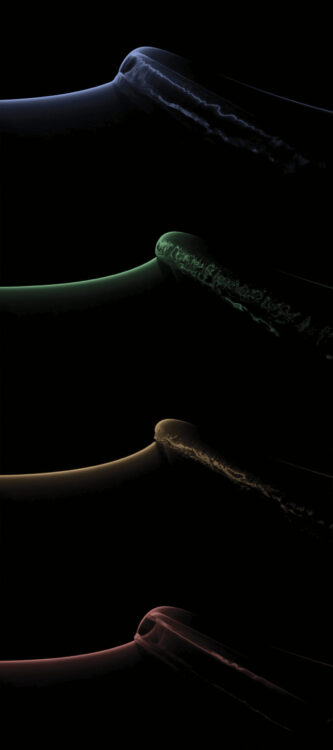
These four images show the two-dimensional surface profile of plunging breaking water waves at the moment of jet impact. They demonstrate how surfactants, chemicals that alter the properties of surface tension, affect the physical properties of breaking waves. The top wave (shown in blue) was produced in surfactant-free water, resulting in a smooth plunging jet. In contrast, adding a small amount of surfactants (green wave) leads to a highly irregular jet shape or even no jet formation at all (yellow wave). Surprisingly, adding a large amount of surfactants produces a smooth jet (red wave), similar to the surfactant-free water condition. These results offer new insights into the behavior of breaking waves and have potential broader environmental implications. The wavelength in these images is approximately one meter.
Black Zenith Rising – Unreleased Album 2022

Black Zenith Rising – Unreleased Album 2022

Ilya Chugunov (graduate student)

Princeton Computational Imaging Laboratory

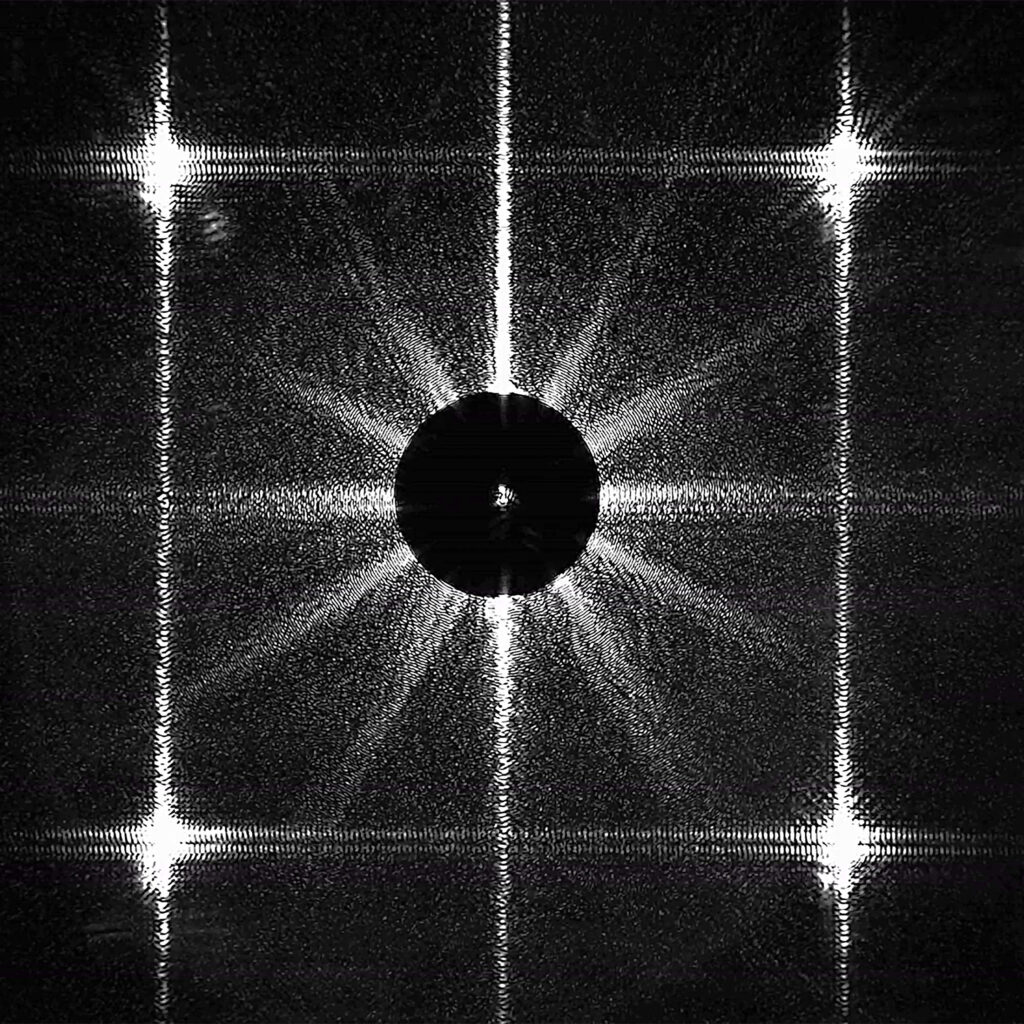
Calibrating optics often involves a lot of staring at black-and-white blobs on a computer monitor. Light waves reflected off polished mirrors, blocked by metal irises, and transmitted through a series of glass lenses interact with each other to form a complex pattern of bright and dark regions in the image. Sometimes, as a researcher, you get caught up in the science. You see this image as a product of misaligned optics, light bleeding into your setup where it shouldn’t. But sometimes, you take a step back and think to yourself: “This would make a pretty awesome album cover for a prog rock band.”

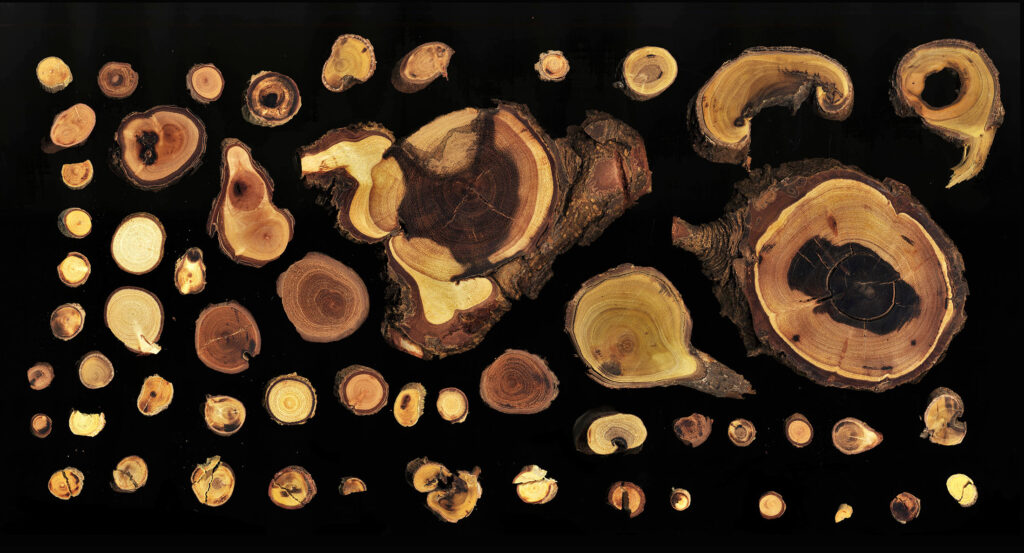
(Jury Award) (Tree) Rings of Fire

(Tree) Rings of Fire

Joel Abraham (graduate student), Carla Staver (faculty)

Ecology and Evolutionary Biology

Much like the trees in North America, some tree species in African savannas create annual growth rings that extend all the way down to their roots. But African savannas are fire-prone systems, and the trees in African savannas burn down and regrow from their roots repeatedly. By comparing the number of growth rings in their stems with their roots, it is possible to figure out when a tree last burned. In this way, the trees in African savannas keep a record of the history of local fires.

Spectroscopic View of the Ring Nebula

Spectroscopic View of the Ring Nebula

Robert Vanderbei (faculty)

Operations Research & Financial Engineering, Astrophysics, Mechanical & Aerospace Engineering, Computer Science, Program in Applied & Computational Mathematics

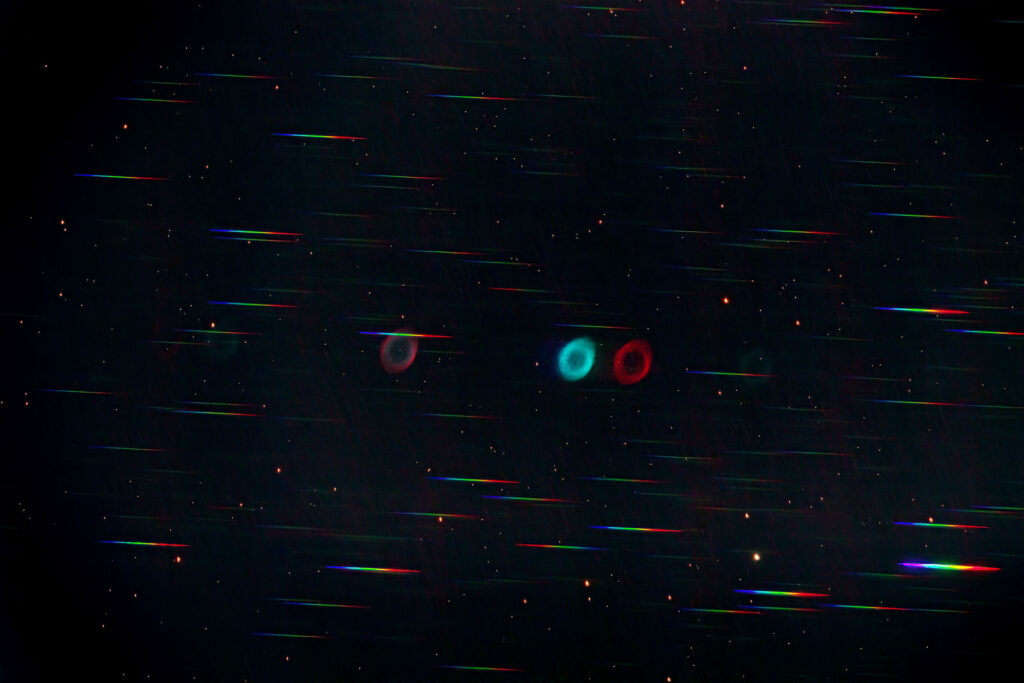
The Ring Nebula is a planetary nebula in the northern constellation of Lyra. It is light emitted from hot, ionized hydrogen and oxygen gas that has been expelled from an old dying star located at the center of the ring. The picture was taken with a telescope and a diffraction grating inserted in the optical path. Each star appears both as a star and as a colored spectral strip off to the right of the star. A bit to the left of the center of the image is the Ring Nebula itself. The hydrogen atoms are emitting red light and the oxygen atoms are emitting blue/green light. Hence, the spectral part of the Ring Nebula is not a multicolored smear but just has two colors, the red from the hydrogen emissions and the teal from the oxygen emissions.

Super Flower Blood Moon
LunarEclipse515202_Rishabh_Jain_6x18_rgb_web

Super Flower Blood Moon

Rishabh Jain ’26

Electrical Computer Engineering

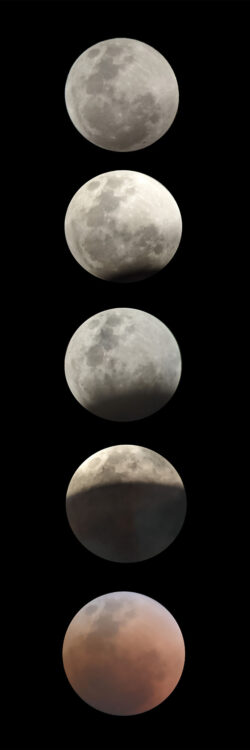
A collage of the Super Flower Blood Moon Lunar Eclipse of May 2022. A lunar eclipse  occurs when the Earth is between the sun and the moon, which casts a shadow on the lunar surface. During a lunar eclipse, the Earth blocks the light from the sun, causing the moon to appear reddish in color, a phenomenon known as a “blood moon.”